

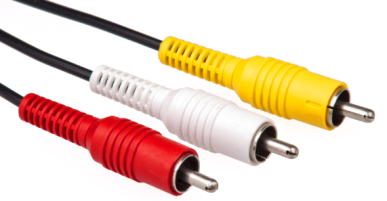
The RCA cable is one of the most widely used analog cables for transmitting audio and video signals between electronic devices. Originally introduced in the 1940s to connect phonographs to amplifiers, it remains common in home entertainment systems today.
RCA cables are still used to connect satellite receivers, DVB-T and DVB-T2 set-top boxes, DVD players, game consoles, older televisions, amplifiers, and many other multimedia devices. Depending on the application, they are available with one, two, or three connectors, with the RCA 3 × 3 cable being the most common version.
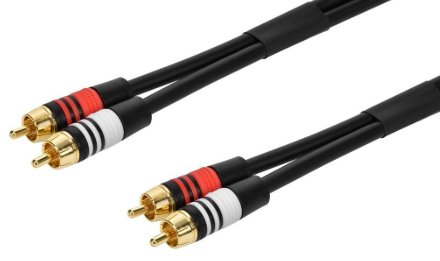
Dual RCA Cable (RCA 2 × 2)
A dual RCA cable consists of two connectors—typically red and white. It is commonly used to transmit stereo audio between devices, although some equipment uses one connector for video and the other for mono audio.
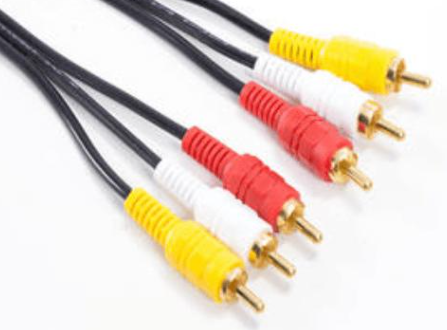
Triple RCA Cable (RCA 3 × 3)
The triple RCA cable adds a yellow connector for composite video, while the red and white connectors carry the right and left stereo audio channels.
- Yellow — Composite video
- White — Left audio channel
- Red — Right audio channel
RCA to 3.5 mm Jack Cables
Modern TVs, portable devices, and media players are becoming increasingly compact, leaving little room for three full-size RCA connectors. To save space, manufacturers often replace them with a single 3.5 mm AV jack.
To connect these devices to standard RCA equipment, a cable with three RCA connectors on one end and a 3.5 mm jack on the other is commonly used.
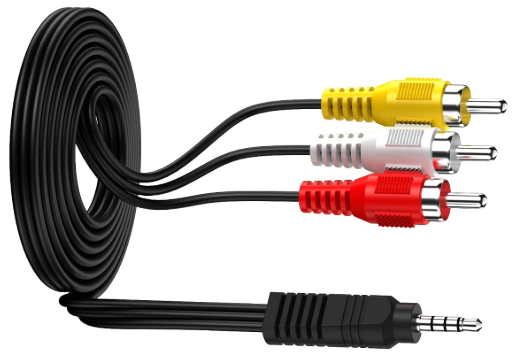
However, these cables are not always interchangeable. Different manufacturers may use different internal pinouts, and some devices require either a 15 mm or 17 mm jack plug. There are also less common versions that use a 2.5 mm jack instead of the standard 3.5 mm connector.
Learn More About RCA to 3.5 mm Cables
If you want to understand the different pinouts, plug lengths, and compatibility issues of RCA to 3.5 mm cables, read our detailed guide here.