

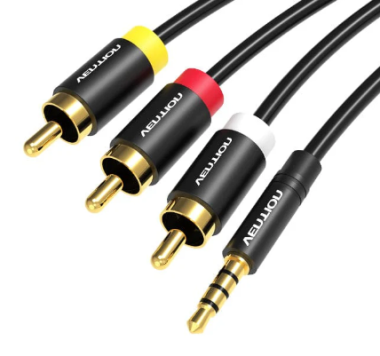
As modern electronic devices become increasingly compact, manufacturers have less space for large connectors such as RCA and SCART. Instead, many devices now use the much smaller 3.5 mm audio/video jack.
To connect older equipment with modern devices, manufacturers introduced the RCA to 3.5 mm jack cable. One end of the cable has three RCA connectors, while the other uses a single 3.5 mm plug.
Why RCA to 3.5 mm Cables Are Not Always Compatible
Unfortunately, there is no universal wiring standard for RCA to 3.5 mm AV cables. Different manufacturers use different pin assignments, which means that two cables may look identical but have completely different internal wiring.
As a result, you may find that the audio and video signals do not match the connector colors. In many cases, swapping the yellow and red RCA plugs solves the problem. Less commonly, you may need to swap the yellow and white connectors instead. These differences are caused by the varying internal pinout used by different manufacturers.
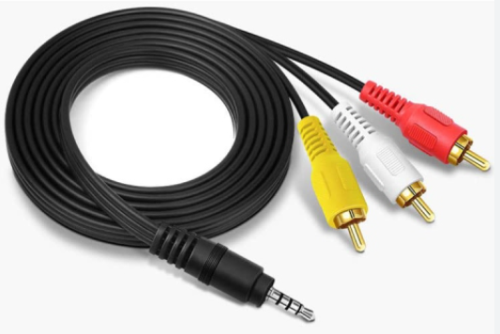
15 mm vs. 17 mm 3.5 mm Jack Plugs
Another source of confusion is the length of the 3.5 mm plug itself. While the traditional standard uses a 15 mm plug, some manufacturers later introduced a 17 mm version for specific devices.
This often creates confusion when purchasing a replacement cable. If you no longer have the original cable, it can be difficult to know which version your equipment requires.
Fortunately, a 17 mm plug usually works in both 15 mm and 17 mm sockets. When used in a 15 mm socket, the plug simply protrudes slightly without affecting normal operation.
However, the opposite is not true. A 15 mm plug typically cannot make proper contact inside a 17 mm socket and may fail to transmit audio or video signals.
Don’t Forget About the 2.5 mm Version
Although much less common, some devices use a 2.5 mm jack instead of the standard 3.5 mm connector. These require a dedicated RCA to 2.5 mm jack cable, which is not interchangeable with the 3.5 mm version.
Before purchasing a replacement cable, always verify both the connector diameter and the plug length. This simple check can save time and help avoid frustrating compatibility issues.
Key Takeaway
RCA to 3.5 mm cables may appear identical, but differences in internal wiring and plug length can prevent them from working correctly with certain devices. Before buying a replacement, check the required pinout, plug length (15 mm or 17 mm), and whether your equipment uses a 3.5 mm or 2.5 mm jack. Choosing the correct cable ensures reliable audio and video transmission without unnecessary troubleshooting.